How to Price Epoxy Floor Jobs Without Leaving Money on the Table
Epoxy Flooring Class Team · September 12, 2026 · epoxy flooring pricing, how to price epoxy floor jobs, epoxy floor cost per square foot, epoxy floor quote calculator, contractor training
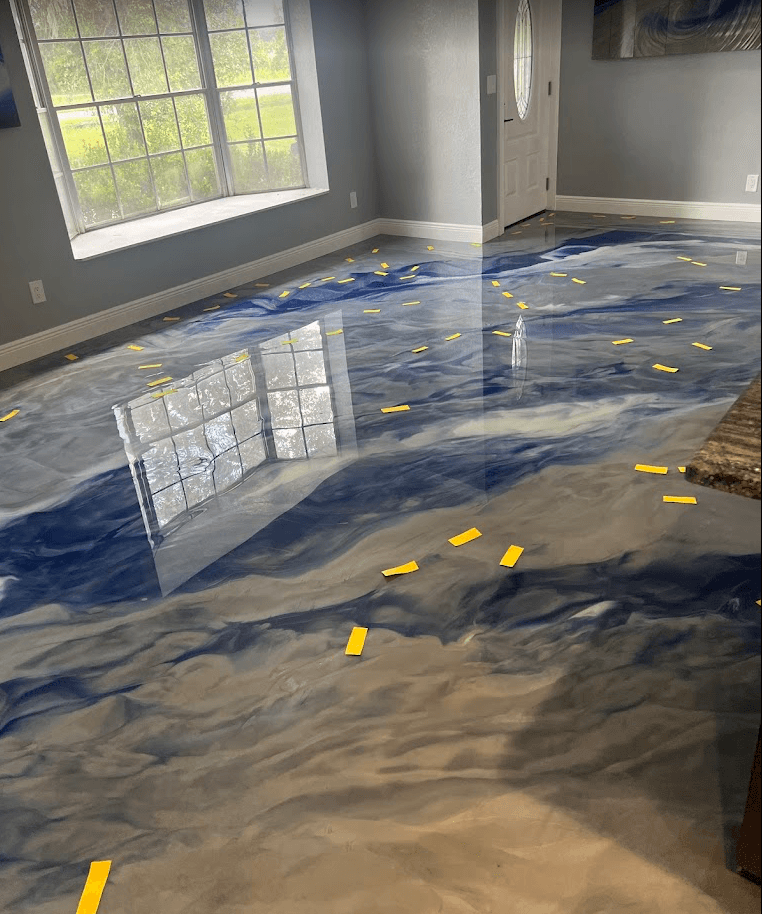
Most new epoxy contractors lose money the same way. They measure the floor, look up a price per square foot online, and throw out a number. They win the job, then realize mid-install that they forgot the moisture barrier, the crack repair, and an hour of surface prep. That one oversight can turn a profitable day into a breakeven day or worse.
This post shows you how to price epoxy floor jobs the right way. We will cover the four things every quote needs, how to price each coating system, the add-ons that most people forget to bill for, and a full worked example on a 450 sq ft two-car garage. At the bottom you will find a link to the free calculator on our site that runs this math for you in minutes.
Why Guessing on Quotes Loses You Money
Epoxy floor pricing looks simple from the outside. The problem is that a garage floor that looks clean can still have high moisture vapor transmission, old failed coating, or cracks that need filling before you lay down a single drop of epoxy. If you do not account for those conditions before you quote, you absorb the cost after.
Consider the math. A full flake system on a 450 sq ft garage runs about $1.45 per sq ft in materials. That is $652.50 in coating costs before consumables, which add roughly $85 per job. If you forgot a moisture vapor barrier on that slab, that is another $1.25 per sq ft, or $562.50 you are eating. One missed line item on one job can wipe out your margin for the day.
Pricing is not about charging the highest number you can get away with. It is about knowing your costs so you never surprise yourself.
The Four Things Every Epoxy Quote Needs
Before you type a single number into a proposal, you need four pieces of information.
1. Square footage. Measure the floor twice. Include alcoves and utility areas. For a standard two-car garage, plan on roughly 450 sq ft as a starting point, but measure the actual slab.
2. Coating system. Each system has a different material cost, labor time, and price range. Solid color, full flake with polyaspartic top, metallic, and quartz broadcast are four distinct products with four different price points. More on that below.
3. Slab condition. Walk the slab before you quote. Look for:
- Moisture or efflorescence (white powder on the surface)
- Existing failed coating that needs removal
- Cracks and control joints that need filling
- Pitting or spalling that needs repair
Each of those conditions adds a line item. None of them should be surprises on install day.
4. Your labor rate. You need to know what you need to earn per hour, not what someone else charges in another market. Factor in drive time, setup, cleanup, and any crew members. Your labor rate is yours to set. The install times below give you the hours to price against.
How to Price Each Coating System Per Square Foot
Here are the four main systems, with material cost, installed price range, and approximate labor time. These numbers reflect the Des Moines metro market in the current year. Your market and your costs will vary. Treat these as a framework, not a guarantee.
Solid Color Epoxy
- Installed price range: $4.50 to $6.00 per sq ft
- Material cost: about $0.95 per sq ft
- Labor: about 1.6 hours per 100 sq ft
This is a single color base coat with a clear topcoat. It is the fastest system to install. It works well for light commercial spaces and utility floors where appearance matters less than durability.
Full Flake with Polyaspartic Top
- Installed price range: $5.50 to $7.50 per sq ft
- Material cost: about $1.45 per sq ft
- Labor: about 2.0 hours per 100 sq ft
This is the standard garage floor system. The flake broadcast hides minor surface imperfections and the polyaspartic topcoat is hot-tire resistant. Most residential customers are shopping for this system even if they do not know the name.
Metallic Epoxy
- Installed price range: $8.00 to $12.00 per sq ft
- Material cost: about $2.10 per sq ft
- Labor: about 2.4 hours per 100 sq ft
Metallic systems produce a showroom look with swirls and depth. They take more skill and more time. Quote them at the top of the range until you have the reps to move fast. Learn how to install metallic epoxy in a hands-on setting before you sell this system to paying customers.
Quartz Broadcast
- Installed price range: $7.00 to $10.00 per sq ft
- Material cost: about $1.90 per sq ft
- Labor: about 2.3 hours per 100 sq ft
Quartz systems are slip resistant and hold up well in wet areas, commercial kitchens, and shop floors. If you are marketing to restaurant owners or car washes, learn this system.
The Add-Ons Most Contractors Forget to Bill For
This section is where pricing mistakes happen. These line items are not optional services you tack on to upsell. They are real work that takes real time and real materials. Leaving them off your quote means you do the work for free.
Moisture Vapor Barrier Primer
Price: $1.25 per sq ft
High moisture slabs need a vapor barrier primer before the coating goes down. If you skip this step on a wet slab, the floor will peel. If you forget to quote it, you either install it and eat the cost or skip it and come back for a warranty call. Neither is a good outcome. Test moisture before every quote and add this line item when the slab needs it.
Crack and Joint Repair
Price: $6.00 per linear foot
Cracks need to be ground out and filled before coating. Walk the slab, measure the cracks, and add the footage to your quote. Control joints also need to be addressed. Customers often expect this to be included in the base price. It is not. Explain why it is a separate line item and most customers understand.
Epoxy Cove Base
Price: $12.00 per linear foot
Cove base is the curved transition between the floor and the wall. Commercial customers often require it. Residential customers love the finished look once they see a photo. Measure the perimeter, quote the footage, and add it. Many contractors skip quoting cove base because it feels like an upsell. It is not. It is part of a complete installation.
Old Coating Removal
Price: $1.50 per sq ft
Failed or peeling epoxy must come off before a new coating goes down. This is grinding work and it adds significant time. Never assume the price per square foot you quoted for the new coating covers coating removal. Quote it as a separate line item every time.
Slab Repair
Slab repair for pitting and spalling adds about $0.25 per sq ft in materials and $0.75 per sq ft to the installed price. Include this when the slab condition warrants it.
Worked Example: 450 Sq Ft Two-Car Garage, Full Flake
Here is how the math looks on a real job. A customer calls about their two-car garage. It measures 450 sq ft. They want full flake with a polyaspartic topcoat. You walk the slab and find it passes the moisture test, but there are about 12 linear feet of cracks.
Base coating (full flake, mid-range at $6.50 per sq ft): 450 sq ft x $6.50 = $2,925
Crack and joint repair: 12 linear feet x $6.00 = $72
Consumables: $85 (standard per-job estimate)
Subtotal: $3,082
Now run the same job but the slab has elevated moisture and the customer also wants a vapor barrier primer.
Moisture vapor barrier primer: 450 sq ft x $1.25 = $562.50
Revised total: $3,644.50
That $562.50 difference is not a premium. It is the cost of doing the job correctly. If you had not tested for moisture and not quoted the primer, you would have installed it at your own expense or skipped it and faced a callback.
Illustration, not a promise. Your prices and costs will vary.
For your own material costs, confirm the current numbers on the product pages before you finalize any quote. Markets and product pricing change.
Using a Pricing Calculator So You Do Not Miss a Line Item
Running this math by hand on every quote takes time and it is easy to forget a line item when you are on a job site talking to a customer. A structured calculator walks you through each input in order: square footage, system, slab conditions, add-ons, and consumables. When every quote follows the same structure, you stop leaving line items off.
Our free pricing calculator on the site now includes all the add-ons covered above, moisture vapor barrier, crack and joint repair, cove base, coating removal, and slab repair. Fill in the inputs and it produces a line-by-line estimate you can use as the basis for a formal proposal.
Get the free First Floor Playbook which includes the calculator and a simple one-page proposal template you can use on your first job.
Learning to Install and Sell in the Same Place
Knowing how to price a floor is half the skill. The other half is being able to walk onto a slab and produce a result the customer will pay for without a callback. Our 3-day hands-on epoxy flooring class in Clive, Iowa covers both. You finish a real floor during class. You also work through pricing and business basics so you leave knowing what to charge and how to explain it to a customer.
Students come in from across the US. The class runs once a month in English and once a month in Spanish. Groups stay under 30 people so every student gets floor time.
What to Do Next
Pick one job you have quoted in the past few months. Go back through it using the four inputs: square footage, system, slab condition, your labor rate. Add up the line items you missed. That number is what better pricing would have put in your pocket.
Then use the calculator to build a quote the right way before your next conversation with a customer.
Get the free First Floor Playbook and start quoting with confidence.
---
Frequently Asked Questions
How much should I charge per square foot for epoxy flooring?
It depends on the system. Solid color epoxy runs $4.50 to $6.00 per sq ft installed. Full flake with polyaspartic runs $5.50 to $7.50. Metallic epoxy runs $8.00 to $12.00. Quartz broadcast runs $7.00 to $10.00. These ranges reflect the Des Moines metro market. Your market may be higher or lower. Always confirm your material costs before finalizing a quote.
What add-ons do epoxy floor contractors most often forget to bill for?
The four most commonly missed line items are moisture vapor barrier primer ($1.25 per sq ft), crack and joint repair ($6.00 per linear foot), epoxy cove base ($12.00 per linear foot), and old coating removal ($1.50 per sq ft). Each of these is real work with real material cost. Leaving them off a quote means doing the work at zero profit.
How do I know if I need a moisture vapor barrier on a slab?
You test before you quote. A simple plastic sheet taped to the slab for 24 hours can show surface moisture. For a more accurate reading, use a calcium chloride test or a relative humidity probe. If the slab fails the test, add the moisture vapor barrier primer to your quote. Do not skip the test and do not skip the line item if the slab needs it.